How It Works · Equipment Guide
How does
the equipment move?
Weights and pulleys, springs, rotating handles and a curved barrel. Here is a plain-language guide to how Gabby Studio's eight machines support and strengthen the body, along with the official manuals and safety guidelines published by their manufacturers.
BASICS
Every machine runs
on two kinds of force
Once you understand how the equipment works, your sessions become far more interesting. The key ideas are "weights and pulleys" and "springs."
Weights and pulleys: the same load from start to finish
A weight hung on a pulley is moved by the pull of the Earth, that is, gravity. A pulley only changes the direction of the force, so whether you pull the cord a little or a lot, the weight feels almost the same. That is why the movement stays even and smooth from beginning to end. The GYROTONIC Pulley Tower uses this principle.
Springs: the further they stretch, the heavier they get
A spring pulls harder the more it is stretched. Physicists call this Hooke's law (F = kx). So the further you push the moving platform on a Reformer (the carriage), the heavier it gets, and on the way back the spring draws your body in. A spring is both resistance and assistance that supports the body.
The first Pilates reformer looked different from today's. Joseph Pilates's US patent "Gymnastic apparatus," filed in 1925 and granted in 1927, featured a wheeled carriage and shoulder rests, and its resistance came from weights hung on pulley cords. Springs were described only as an alternative. Today Pilates mainly uses springs and GYROTONIC mainly uses weights and pulleys, so the two families of equipment turn out to have surprisingly close roots.
GYROTONIC® 01
Pulley Tower
Combination Unit
The foundational machine, described by GYROTONIC headquarters as its "most widely used" piece of equipment. Its design has been refined for more than 30 years.
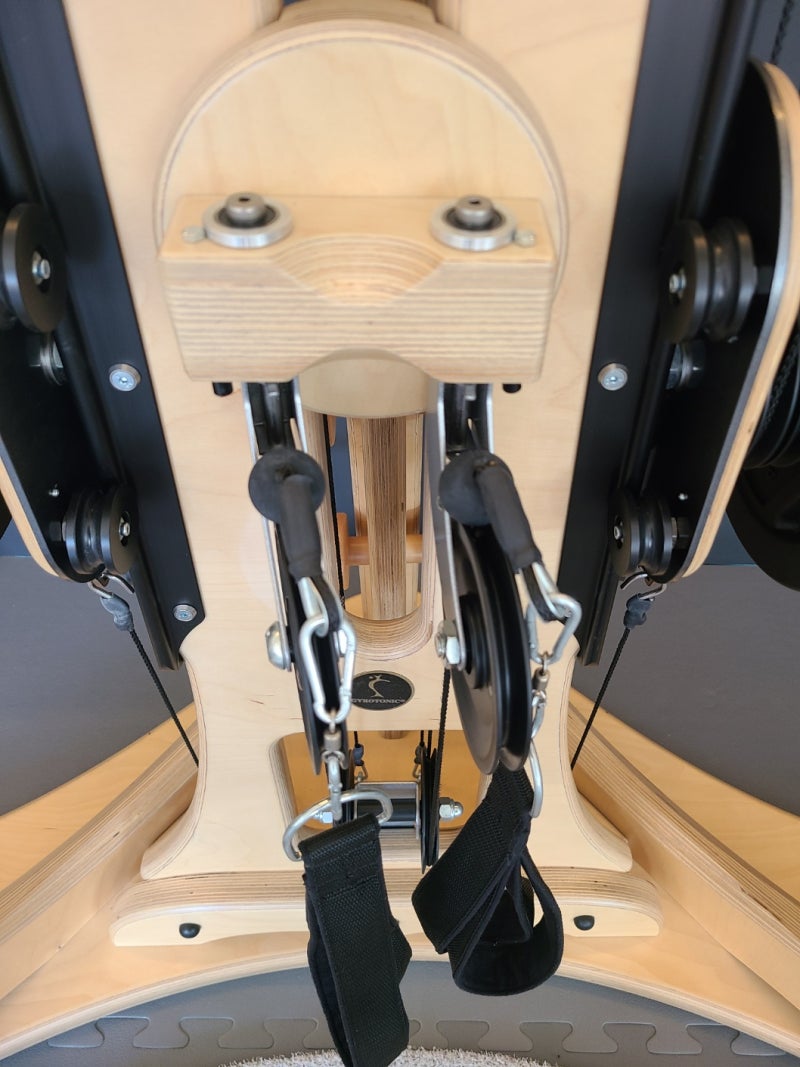
- TowerA pulley system with weights attached. The pulleys can be set high, middle or low to choose the direction in which the arms and legs are pulled. It stands about 2 m tall.
- BenchA height-adjustable platform for exercising lying down or seated.
- Handle UnitThe rotating wheels at the front. Holding the handles and tracing circles, you perform movements such as the "Arch and Curl," which rounds and extends the spine.
- StrapsLoop your hands or feet in them to move the legs in circles and spirals. The weights support the weight of the legs, so there is little strain on the joints.
Why does it feel so smooth?
Headquarters describes this as equipment that "guides, assists and challenges." Weights and pulleys give an even, steady force that never starts or stops abruptly, so the body can move rhythmically through uninterrupted circles and spirals. Because the movement feels like it opens space in the joints rather than compressing them, intensity can be fine-tuned even for people in pain or recovering from surgery.
Higher-end models can add springs at the back of the tower for more resistance. Since many exercises are done seated, there are also models whose height and angle can be changed so they can be used from a chair or wheelchair.
GYROTONIC® 02 · SPECIAL
Archway
Described by headquarters as its "most physically challenging specialized equipment."
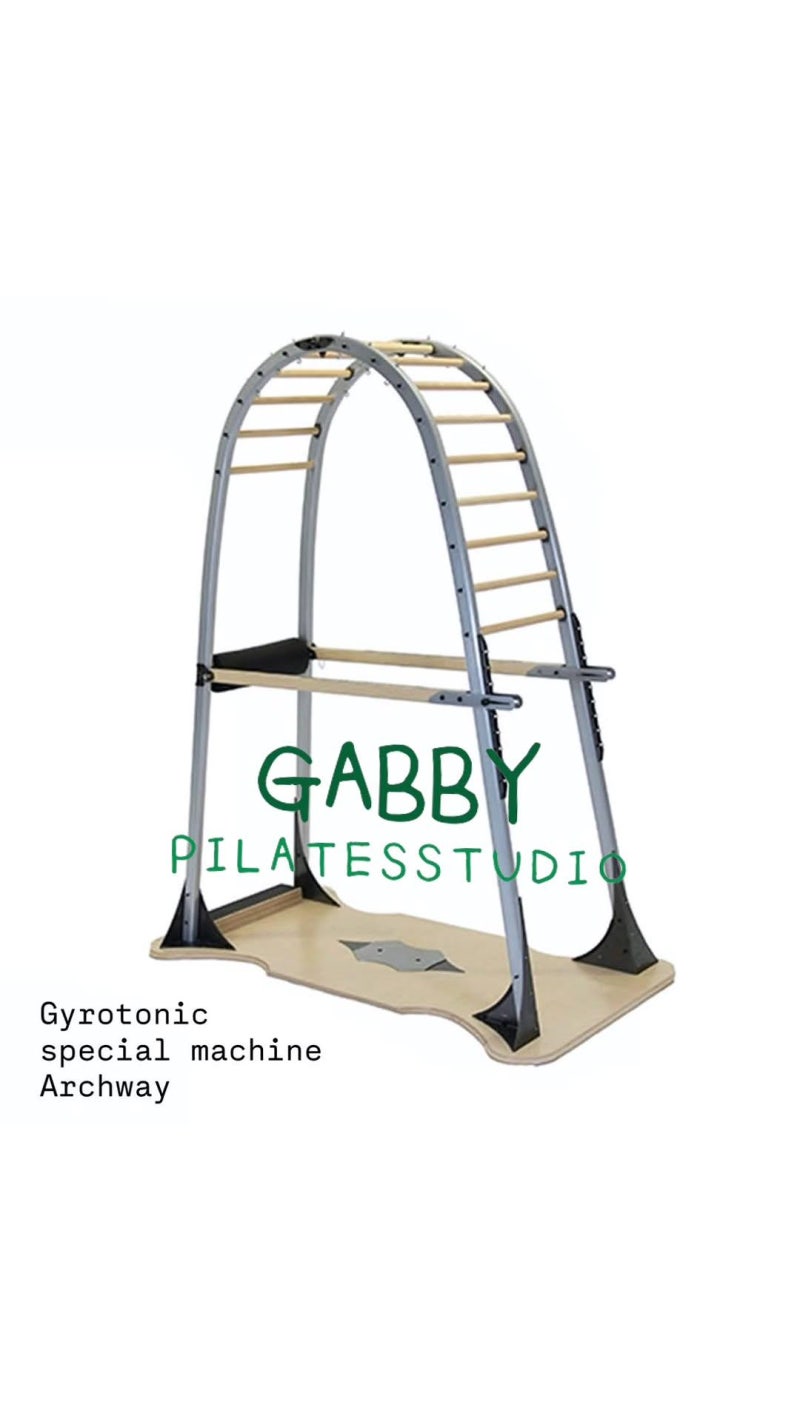
A tiered, vertical ladder-like frame. At about 95 inches (roughly 2.4 m), it is the tallest piece of GYROTONIC equipment. Holding or leaning on the frame, you train strength and balance in many directions: vertical, horizontal, diagonal and even inverted.
With the propeller attachment and adjustable arms mounted on the frame, you can also do standing rotational movements. What sets it apart from other machines is that it lets you do movements normally done lying on the floor while standing, hanging and twisting.
| Size | 79 in long × 41 in wide × 95 in high (48 in wide with propellers) |
|---|---|
| Training planes | Vertical · horizontal · diagonal · inverted |
| Recommended for | People comfortable with the foundational equipment who want to build more balance and full-body strength |
GYROTONIC® 03 · SPECIAL
Jumping-Stretching Board
Equipment for "running and jumping lying down," with no impact on the joints.
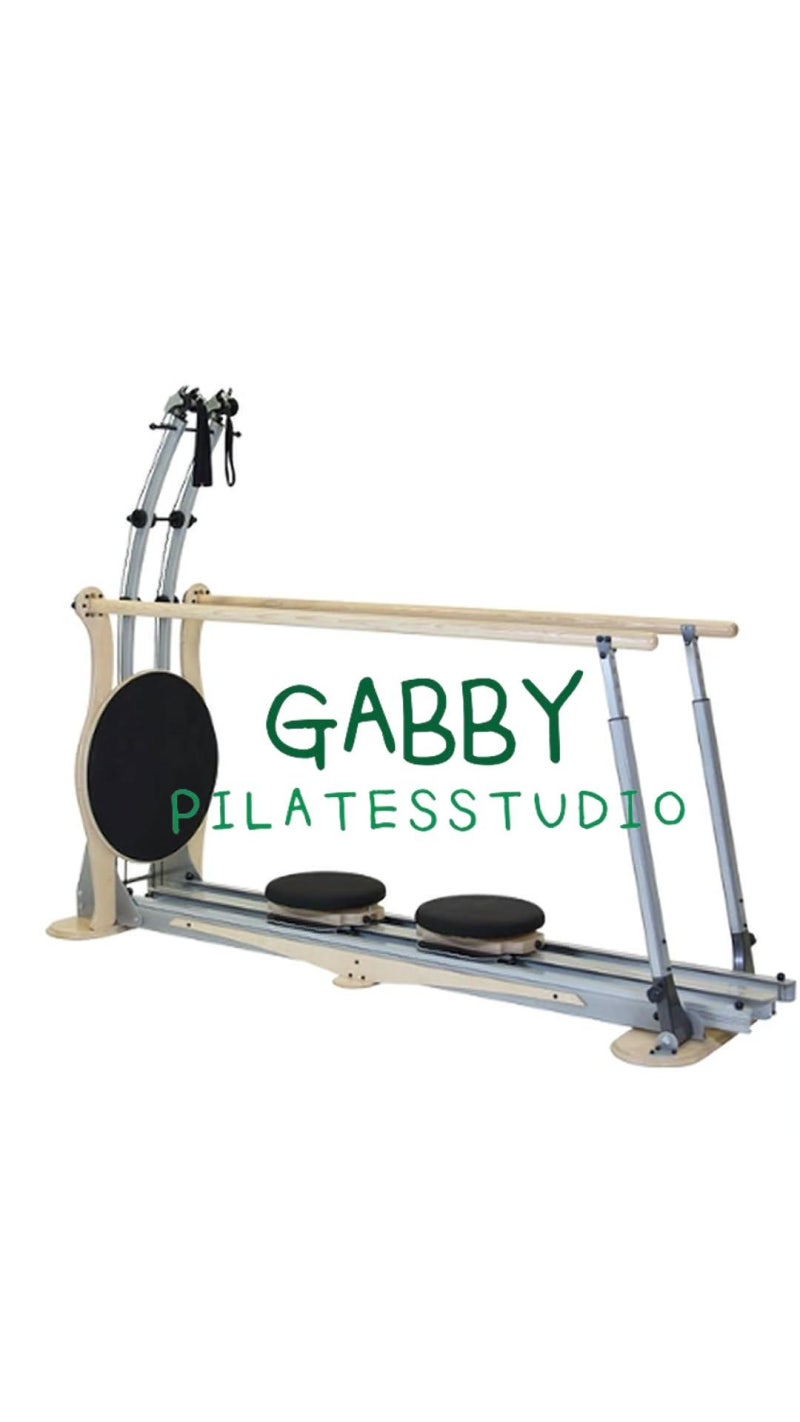
It has four independently moving slides on rails. With the spine and pelvis supported by the equipment and the hands and feet on the slides, you run and jump on a horizontal plane. There is no impact from landing on the ground, so there is little strain on the knees and ankles. Adding a rotating platform also allows foot-rotation movements.
According to founder Juliu Horvath's patented design, each slide rolls along a rail and spring cords running over pulleys provide resistance independently. So the right and left feet, and the hands and feet, each move against a different force, building left-right balance and coordination. The incline of the rails can also be changed.
| Positions | Kneeling · standing · lying · seated |
|---|---|
| Components | Four independent slides, rotating platform (optional), propellers, Pulley Tower included |
| Size | 96 × 35 × 75 in assembled · 105 × 48 in workout area |
GYROTONIC® 04 · SPECIAL
Leg Extension Unit
A special design in which the equipment lengthens along with you, so extending the legs does not compress the joints.

The key is a cam mechanism patented by headquarters. As the legs extend, the equipment lengthens by the same amount, so the hips and knees move without being compressed. Even though it is a leg-extension exercise, space is preserved within the joints.
With straps on the hands and feet, you perform full-body movements that use the upper and lower body, hands and feet together. One side of the body and the other move in different directions and across multiple planes, with the aim of building functional strength and stability in every joint.
| Components | Hand and foot straps, aluminum Wingmaster |
|---|---|
| Size | 76 × 33 × 27 in fully extended (72 in wide with Wingmaster) |
| Instructor qualification | Only trainers who have completed the dedicated Leg Extension foundation course may teach on it |
No official, established program has been published on how to use this equipment in hip, knee or ankle rehabilitation. At Gabby Studio, whether to use it and at what intensity is decided after a consultation and movement assessment, based on your condition.
PILATES 01
Reformer
The signature piece of Pilates equipment. Manufacturer manuals also call it the "Pilates Universal Reformer."
- CarriageA moving platform on wheels. You lie, sit or kneel on it.
- SpringsConnect the carriage to the frame. Intensity changes with how many springs are attached, and of what strength.
- FootbarA bar you push with your feet or hands. Its height adjusts in several steps, and it can be lowered out of the way entirely.
- Ropes · strapsRun over pulleys and connect to the carriage. You loop your hands or feet in them and pull.
- Headrest · shoulder restsSupport the neck and shoulders and keep you from sliding on the carriage.
- Spring barWhere the springs attach; it adjusts the carriage position and the springs' starting tension to your height.
Three effects created by springs
① The further you go, the heavier it gets. Because of Hooke's law, the further you push the carriage, the more effort it takes. Even within a single movement, the intensity naturally changes from one phase to the next.
② The return is exercise too. While the springs draw the carriage back, the muscles lengthen as they resist that force and control the slow return. That is why Pilates emphasizes "return as slowly as you push."
③ Lighter does not mean easier. As the manuals also note, in some movements removing springs to lighten the load actually makes the carriage less stable, so your body has to hold it steady. That is because springs are both resistance and support.
What do the spring colors mean?
| Yellow | Very light |
|---|---|
| Blue | Light |
| Red | Medium |
| Green | Heavy |
Based on the US Balanced Body reformer. Colors and strengths vary by manufacturer.
"Footwork," pushing the footbar with the feet on the Reformer, is a closed-chain exercise in which the feet stay fixed while the legs push away. It resembles the leg press at a gym, but because it is done lying down, it builds leg strength while reducing strain on the lower back and knees, which is why it is often used in rehabilitation.
PILATES 02
Cadillac
Also called the "Trapeze Table," a bed-shaped machine surrounded by a metal frame.
A metal post frame rises over a padded table like a canopy. Hooks all over the frame let you attach springs low, middle, high or overhead, so the direction of pull can be changed freely even for the same movement. Since you can exercise lying down, it is especially good for people who are frail or in the early stages of rehab, and for stretching.
- Push-through barA hinged bar. With springs attached from above or below, you push or pull it. The pivot height can be set at three levels.
- Roll-down barA spring-loaded bar you hold to help roll the spine down one vertebra at a time.
- TrapezeA swing hung from the overhead frame, used for hanging and lifting the body.
- Springs · fuzziesThere are short and long springs for the arms and legs, used with soft loops (fuzzies) that go around the ankles and wrists.
The story that "the Cadillac began when springs were attached to hospital beds in a World War I internment camp so patients could exercise" is famous, but it is a legend not confirmed by records. The origin of the name "Cadillac" has also only been passed down by word of mouth. You can read more in Chapter 5 of the Rehab Story.
PILATES 03
Chair
It looks like a small box, but it is considered the hardest piece of Pilates equipment to balance on.
Under the seat is a spring-loaded pedal. You press the pedal down with your hands or feet, then resist the springs as you let it rise slowly. Because the seat is narrow and the pedal moves, your body has to find its own center. That makes it good for building balance and core stability along with lower-body strength.
Joseph Pilates filed a patent titled "Chair" in 1931 and was granted it in 1934. The device in the patent served as a chair in everyday use and became exercise equipment when turned over, with springs attached to a tilting seat. The story that it was an "at-home reformer" for small New York apartments is widely told in the industry, but it has not been confirmed by primary records.
PILATES 04
Ladder Barrel
No springs: you work with a curved "barrel," a "ladder" and your own body weight.
A semicircular barrel and a ladder are joined as one unit. You lean back with your back on the barrel's curve, lie on your stomach to extend the body, or lie on your side to lengthen the torso. It is well suited to bending the spine forward (flexion) and arching it back (extension) and to deep stretching, so it is often used for stiff backs and posture correction.
The distance between the ladder and the barrel is adjusted to leg length. On the Balanced Body model, stepping on a foot-operated lever lets the barrel slide along its base and lock into one of 10 marked positions (about 25 cm). Hooking the feet under the lower foot rungs keeps the body stable.
SAFETY
Safety guidelines
from the manufacturer
A plain-language summary of the key points from the safety and maintenance manuals published by Pilates equipment maker Balanced Body. Always use the equipment under an instructor's guidance.
- Spring replacementReplace all springs at least every 2 years, or every year for equipment used in group classes.
- Spring inspectionStop using a spring immediately if gaps open between its coils, or if it is bent or rusted. Check the hooks every month as well.
- No snapping backNever let springs or pedals snap back; always return slowly and under control.
- Before using the ReformerCheck that the footbar is securely locked and the ropes are properly threaded. The ropes must not go slack, and the carriage must not slam into the end.
- Reformer storageEven when not in use, keep at least two springs attached so the carriage cannot move on its own.
- Cadillac push-through barFor movements with springs attached from below, use a safety strap so the bar cannot drop, and the instructor keeps a hand on the bar to assist.
- Ropes · strapsInspect every 3 months, and immediately replace ropes with a visible core or flattened spots, and frayed straps.
- Bolts · railsTighten bolts monthly, and clean the rails with a mild detergent with the springs removed. Use only dry silicone on the pulleys, never oil.
GYROTONIC equipment can be purchased and taught only by instructors who have completed training certified by headquarters. Each piece of specialized equipment also requires its own dedicated foundation course before it can be taught. GYROTONIC's operating manuals are not publicly available; if needed, contact headquarters (info@gyrotonic.com) or a regional distributor.
MANUALS
Official manuals · resources
Links to original materials published by the manufacturers. (In English · external sites)
Pilates equipment manuals (Balanced Body)
- PDFReformer usage safety guideReformer Usage Safety Guide
- PDFStudio Reformer · Tower complete user guideStudio Reformer with Tower Complete User Guide
- PDFCadillac (Trapeze Table) complete user guideTrapeze Table Complete User Guide
- PDFEquipment assembly · maintenance · safety guideSafety First: Equipment Assembly & Maintenance
- WEBBalanced Body manuals · safety FAQIncludes guides for other Reformer and Cadillac models
- WEBLadder Barrel product informationUser guide supplied with the product
GYROTONIC® official equipment pages
- WEBPulley Tower Combination Unitgyrotonic.com
- WEBArchwaygyrotonic.com
- WEBJumping-Stretching Boardgyrotonic.com
- WEBLeg Extension Unitgyrotonic.com
The original designs (patent texts)
- PatentJoseph Pilates, "Gymnastic apparatus" (1927) · the prototype of the ReformerUS1621477
- PatentJoseph Pilates, "Chair" (1934) · the prototype of the ChairUS1969901
- PatentJuliu Horvath exercise apparatus (filed 1986) · the prototype of the Handle UnitUS4850586
- PatentJuliu Horvath Jumping-Stretching Board designUS7384384
Gabby Studio's Pilates equipment may come from a different manufacturer than the one behind these materials; they are representative official manuals for the same types of equipment. This page offers general information to help you understand the equipment and does not replace medical diagnosis or treatment.
GABBY STUDIO
Instructors who understand the mechanics
choose your equipment
Even the same movement places completely different forces on the body depending on whether it uses weights or springs, and at what height the pulley is set. After a consultation and movement assessment, Gabby Studio chooses the equipment and intensity that best suit your body right now.
Chat with us on KakaoTalk